By Joan Pritchard
Sugar Land Garden Club
From our March newsletter, our club’s horticulture expert Joan Pritchard discusses the preparations she took in her garden for the many freezes we had this winter and offers advice based on her experience. For early access to these and other informational articles, join the Sugar Land Garden Club so you can get the newsletter delivered to your inbox!
I have gardened in Sugar Land for over 30 years and fell in love with the opportunity to grow so many exotic semi-tropical plants in the garden. Some years winter went by without any frost at all, but most did have at least a short light freeze. I came from a climate where roses had to be planted with the bud-union at least 6 or 8 inches below the ground surface and then the plants still needed a heavy covering of straw to survive the winter. Daffodils had to be planted next to the foundation, so the soil could get just enough warmth from the basement for them to survive. So protecting tender plants on occasion was no big deal. And I was head over heels with glee when I found out that pansies could bloom all winter no matter what.
Fast forward to the new era of climate change. It would seem that we can now expect at least one hard freeze just about every year. The new reality is that tropical gardens are becoming a lot harder to keep alive year after year. Not only that, but plants that have always been fully hardy here are dealing with unusually wild temperature swings, leaving them in the cold after weeks of 80 degree days have prompted them to grow too early and risk losing all the new growth when the temperature plummets into the mid-twenties. That puts gardeners into having to make tough choices. If you have a big garden like I do, it is impossible to cover everything.
This is where I am now. Pricey or hard to replace plants live in pots on the patio and either come into the house or temporary plastic greenhouse for the winter. Potted plants that don’t mind a few degrees of cold stay on the patio and only get moved into the garage when a hard freeze is forecast. Small pots that are easy to move can be brought into the house quickly to be tripped over for a day or two. The garage has a small portable heater to keep the plumerias stored there for the winter at about 40 degrees. Since the plants had to stay in the garage for a week while we were gone in January, we also put a halogen work light on a timer, but it isn’t really necessary do that for just a day or two. Fortunately we have enough space that one car can stay in the garage, so we have a warm ride and the heater in the garage can make up for the heat loss coming and going.
In the ground, woody tropicals like hibiscus and ixora, etc. get a deep layer of mulch over their roots and around their lower branches and I just wait until late summer for flowers (or earlier if we get lucky and it doesn’t get too cold). The same goes for tropical plants like angel trumpets and clerodendrum. I would prefer that they not freeze back, but treating them like late flowering perennials is better than nothing. I just can’t cover everything and some are too big anyway.
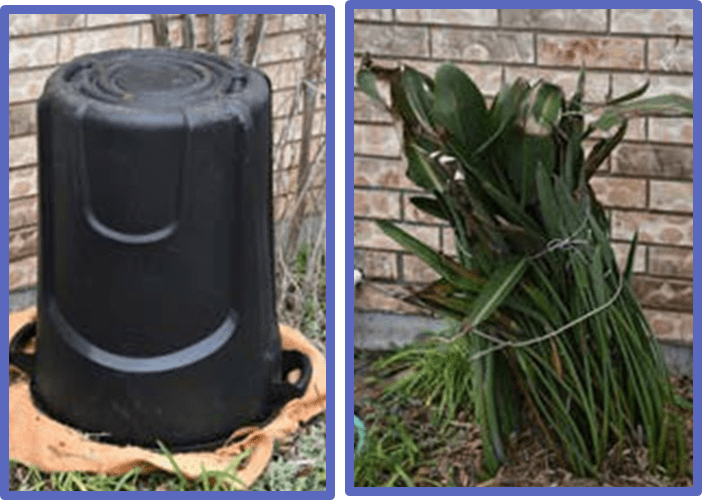
My bird of paradise gets extra royal treatment. We tie it up into a tight bundle, wrap it in a warm blanket and put a plastic garbage can over it it to keep the blanket dry. Works like a charm. The plant looked perfectly fine after the bad freeze in January. Unfortunately that is not something I can do for every plant.
Then there are the winter blooming tropicals. One of my favorites is Eranthemum pulchellum , commonly called “blue sage” (can’t imagine why, since it bears no resemblance whatever to sage) which only blooms from December until early spring and will not set buds again if it freezes back. I also have beds full of red florist’s Kalanchoe, which are absolutely stunning in masses, blooming in January and often lasting until April. I won’t let a few freezing days spoil that show. These plants, along with a giant walking iris, also tropical, get the royal treatment. The blue ”sage” is tied up to form a less unwieldy bundle, then wrapped in a long string of incandescent Christmas minilights and covered with two old padded mattress covers held together with clothespins and edges weighed down with stones or bricks . The lights provide heat and the covers keep out the cold wind.
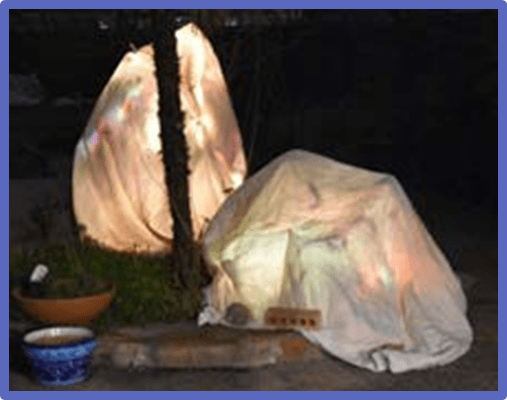
The bed with the Kalanchoes gets the same treatment without the bundling, but a few stakes to raise the covers and prevent crushing of the flower stems . This year I also did the same to a small reblooming azalea I planted last spring which did next to nothing all year after it’s spring bloom, but chose to bloom in January. I don’t know how much cold the buds and flowers can take, but after no bloom since May, I didn’t care to find out. At least that little bush took next to no extra time to cover.
So far we have never had weather cold enough that this effort did not pay off with a beautiful mid-winter color display. This January I didn’t cover anything else except the Ranunculas and whatever was in the bed around them, because I really don’t know how much cold they can take without setting back their bloom. They were already in full leaf after the warm winter weather we had, and they are a one shot planting, so I didn’t want to risk it. Everything else was, or should have been, mostly dormant and able to handle winter on their own.
Fast forward to late February after weeks of weather in the 70’s and 80’s, with spring growth in full swing. Most of the daylilies are 6 to 8 inches high, true lilies are all 2 to 6 inches high, and many perennials have at least some new growth. Narcissus and leucojum are starting to bloom. Another hard freeze is forecast. This time I cover everything I can. There are sheets and blankets all over the yard. Most of the daylilies and true lillies and some amaryllis are covered, but some just won’t fit and I ran out of covers. This is now an experiment to see how necessary cover is for growing plants in 27 degree weather. Most deciduous shrubs have put out new leaves and are on their own. I expect they will quickly replace them if they drop, but many should be okay anyway.
It is now four days later. The covers stayed on both nights, hard freeze and light frost, and came off before the rain on the third night despite weather in the thirties, because it was going to rain and dealing with sodden covers is no fun.
It is now 2 days later and an inspection of the garden shows no difference between covered and uncovered plants of the same species. None of the shrubs already leafing out showed any damage at all, except the gold cestrum, and it will come back.
The lesson I take from this is that if you have hardy plants, it is a waste of effort to go overboard with cold protection for plants that don’t seem to care. Annual bedding plants are a different story, of course. Pansies can handle a fair amount of cold, but even they look somewhat worse for wear after this second cold snap. I am hoping that sunshine and fertilizer will perk them up. My annual seedlings were under the same cover as the ranunculus, so I can’t speak to their cold tolerance. Plants that tolerated the freeze without harm.
It has also come to my attention that, no matter what, weeds are fully freeze proof!
Discover more from Sugar Land Garden Club
Subscribe to get the latest posts sent to your email.
 Sugar Land Garden Club